Colonial relationships with Great Britain
British imperialism
After the Seven Years’ war, British authorities started to think about their empire. Between 1770 and 1782, the Tories in power dreamed of strengthening colonial domination and centralisation. Advocating protectionism, they wanted to strictly apply a mercantilist policy by reinforcing commercial monopoly, encouraging maritim companies and fighting against contraband traffic (= commerce de contrebande). Tories had to face the Whigs’ opposition, who were in favor of free trade.
In America, local laws, elaborated by assemblies and approved by the King, were in principle inferior to british laws, voted by the Parliament. However, colonial assemblies didn’t hesitate to impinge (= empiéter) on governors’ prerogatives by using their scrutiny right (= droit de regard). Fearing an expansion of the Thirteen Colonies to the West, London tried to strengthen its authority after 1763.
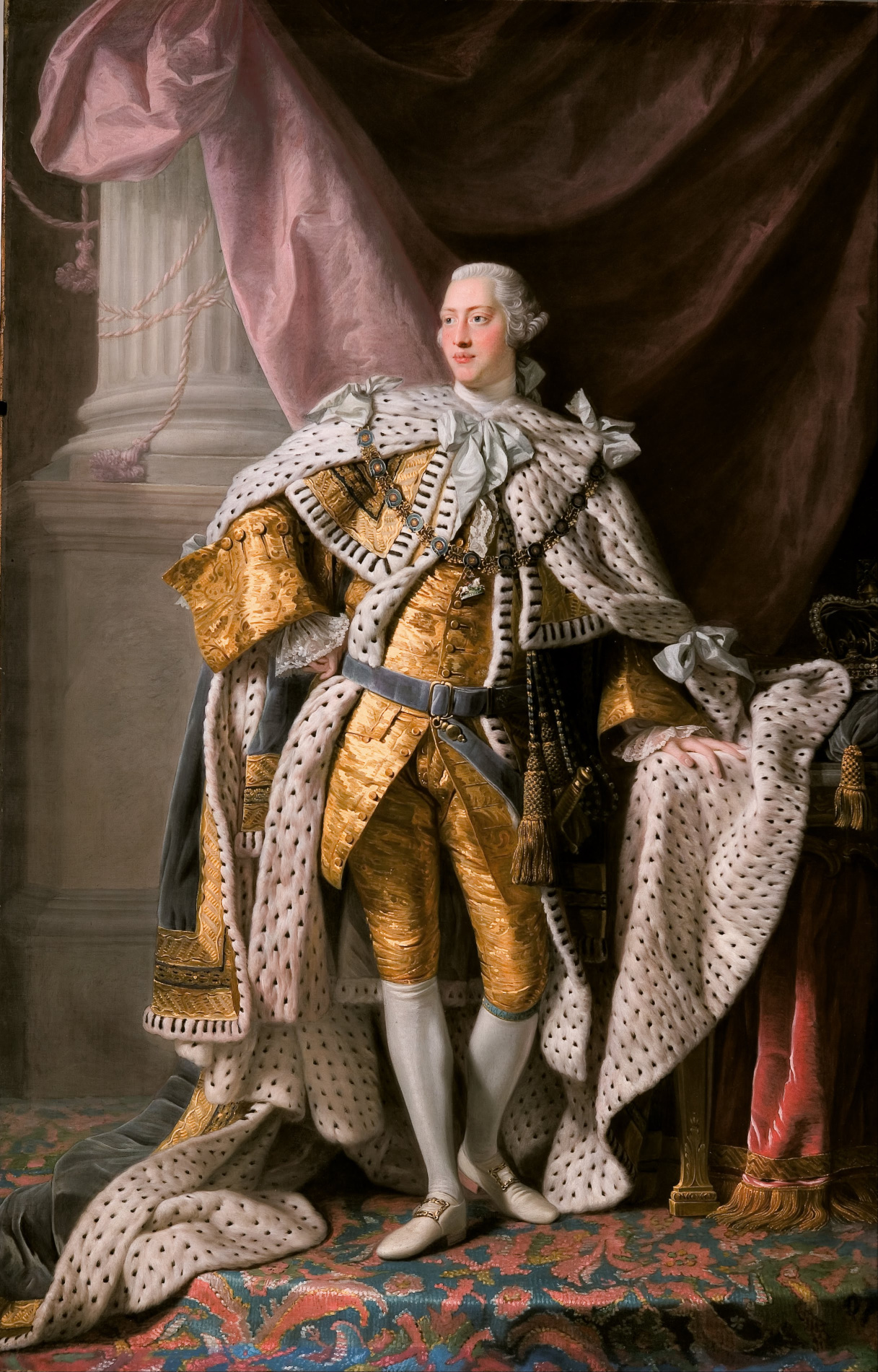
King George III in coronation robes by Allan Ramsay, 1765
Economic litigation (= contentieux)
The colonies economy was marked by mercantilism and exclusivity: with this system, Great Britain wanted to keep a maximum of precious metal and protect British industry and craftsmanship. Commercial relationships were ruled by the Navigation Acts: colonies exported raw materials on British ships, they were transformed in Great Britain and then sold abroad. Manufactured products in colonies should not be exported and several merchandises shall even come from the mainland. In return, American colonies should only buy British products. Foreign ships who traded with the colonies had to go through a British harbor in order to pay custom fees (= frais de douane).
In reality, distance with London and the custom officers’ corruption in America led to a certain laxity in taxes collection. American ships even illegally crossed North Atlantic because of trade’s needs. This infringement (= transgression) of mercantilism and the American competitors quickly worried British merchants. The economic development of America led to some animosity between colonial merchants and the mainland’s capitalists.
American settlers, especially New-England’s merchants, denounced the monopoly on certain goods’ traffic like tea. They also regretted the chronic lack of currency and their dependency towards British credit.
The birth of an American identity
The American economic elite often felt close to the mainland and wanted to imitate the British higher classes. They sent their sons to the United Kingdom to study and had interests in staying in the good graces of London because of the mercantilist system and the order it guaranteed.
Middle class was less attached to the mainland. Settlers born in America felt less and less British. Also, despite the colonies and its inhabitant’s diversity, the British imperialist policy brought to life a “colonial patriotism” turned against London, and the birth of an American identity. Since the 17th century, colonies asserted themselves as a relatively open-minded land, especially towards religion, which was a true contrast with the European situation. The desire of happiness and individual success, linked to social mobility and the opportunities given by the immensity of the territory, constituted in one of the founding principles of the American identity.
However, there were several issues between settlers and between the colonies. Problems about the colonies’ frontiers were frequent. Interests differed even inside a single colony. In Massachusetts, Boston’s inhabitants were opposed to farmers on the West side of the colony. Settlers were always suing (= intenter un procès) one another. This lack of order didn’t stop the independence cause to cross the minds as settlers thought the decline of virtues was due to British oppression.
The Lumières influence
At the end of the 18th century, Philadelphia was the “true center of the revolutionary Lumières”, especially under the impulsion of Benjamin Franklin. The city was, along with Boston, the principal publication center of the Thirteen Colonies and the Pennsylvania Gazette played a major role during the American Revolution. Benjamin Franklin even created a discussion group called The American Philosophical Society. Elites and the Founding Fathers read European philosophers like John Locke, Charles de Montesquieu, Hugo Grotius, Cesare Beccaria, Henry Home or Thomas Hobbes.
British philosopher John Locke’s theories particularly influenced the figures of the American Revolution: the social contract theory implicated the natural right of the people to change their leaders with elections or other means. The Founding Fathers drew from (= puiser) the analysis of the British constitution by Montesquieu, but also in the British texts (Habeas Corpus, Bill of Rights) in order to write the constitutions of the states and the country.
Republicanism was one of the major ideological principles in the colonies on the verge of revolution. Settlers criticized the court’s ostentatious luxe and proposed a republican virtue. The idea that men had the civic duty to fight for their country emerged.
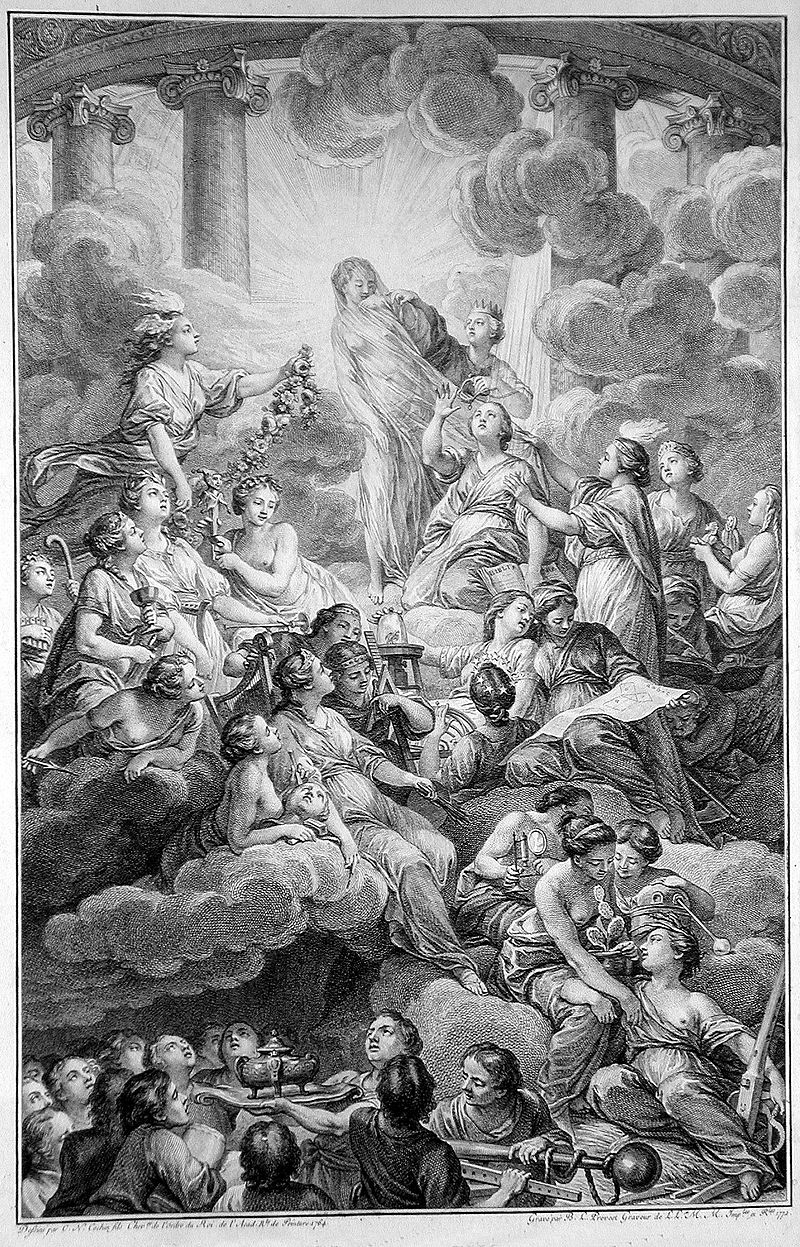
The Encyclopédie’s frontispiece, drawn by Charles-Nicolas Cochin and engraved by Bonaventure-Louis Prévost, 1772