Confederation period, 1781-1789
Since 1781, a new Congress took place, replacing the Second Continental Congress. However, the members of this new assembly were the same as before.
The Congress’ fields of competence were limited: money, citizenship, positions, units of measure. A money was born in 1785, the dollar, to replace British pounds, but mostly the different foreign moneys that circulated throughout North America. The propagation of banknotes continued after the war.
Expansion to the West
Territories west of the Appalachians Mountains, attributed to the United States by the Treaty of Paris, were the stake of rivalries between States. In 1784, in order to put an end to a confusing and threatening situation for the unity of the nation, Thomas Jefferson proposed to divide them in ten districts, each of them becoming a State of the Union as soon as they would reach a certain demographic weight. The Northwest Ordinance (1787) organized territories and forbid slavery.
Military and social turmoil (agitation)
The period that followed the Treaty of Paris was marked by economic slump (= marasme) and a certain social turmoil. In 1783, the Newburgh Conspiracy revealed tensions in the army and shed the light on the urgency to do some institutional reforms.
In June 1783, a mutinies’ (= mutins) group from Pennsylvania invaded the Congress in Philadelphia and threatened some delegates, forced to leave and sit temporarily in Princeton. In 1786-1787, in an economical context disturbed by inflation, the rise of property taxes and currency devaluation, indebted farmers and craftsmen formed a militia led by Daniel Shays, who threatened tribunals. Massachusetts asked the Congress for help. Yet, most of the States refused to put the needed resources in the repression of the riot by individual selfishness. Shays’ Rebellion got stopped in January 1787 but created fear in the head of the elites towards the people. It got imitated in Virginia where tribunals got ransacked (= saccager) and their archives burnt down by rioters. James Madison told his fear to see the implementation of a “despotic” regime under the power of a new Oliver Cromwell (the guy in England y’know). Shays’ Rebellion was a catalyst (= catalyseur) for federalists to demand institutional reforms.
The Founding Fathers realized they were too optimistic about human nature and that public virtue was utopic. Alexander Hamilton got in charge to think about a new project which would take into consideration a more realistic definition of human nature. His founding thought marked the passage to a new pragmatic way of thinking: “Give all the power to the many, they will oppress the few. Give all the power to the few, they will oppress the many.”
Troubles were so important that some people thought they must bring monarchy back in America. But the Founding Fathers didn’t want to abandon after all the sacrifices they made to serve their freedom ideal embodied by the Republic. They wanted to found a new regime which would provide a “republican remedy to the common woes (= maux) of the republican regime”.
The Constitution
The Convention of Annapolis, gathered in September 1786 at the behest of (= à la demande de) Virginia, observed the failure of the Articles of Confederation about organizing trade between States. It planned a new assembly for 1787. The Philadelphia Convention, also known as the Constitutional Convention, reunited from May to September 1787 to write the American Constitution. The 55 delegates talked about slavery, balance between powers and political weight of the States. The constitution project got voted on September 17, 1787, signed by 39 representatives out of 55 and ratified by ¾ of the States on June 21, 1788. The document organized the new institutions of a federalist and republican State in which there would be the separation of powers. This was the first time in History where federalism was applied to such a wide country: federal States kept their political, judiciary, economic, social and fiscal powers while acknowledging the superiority of the federal law. Its originality resided in the combination of republic and democracy, as well as a presidential system never imagined before. By the preamble formula “We the People”, the Constitution also marked the birth of a nation.
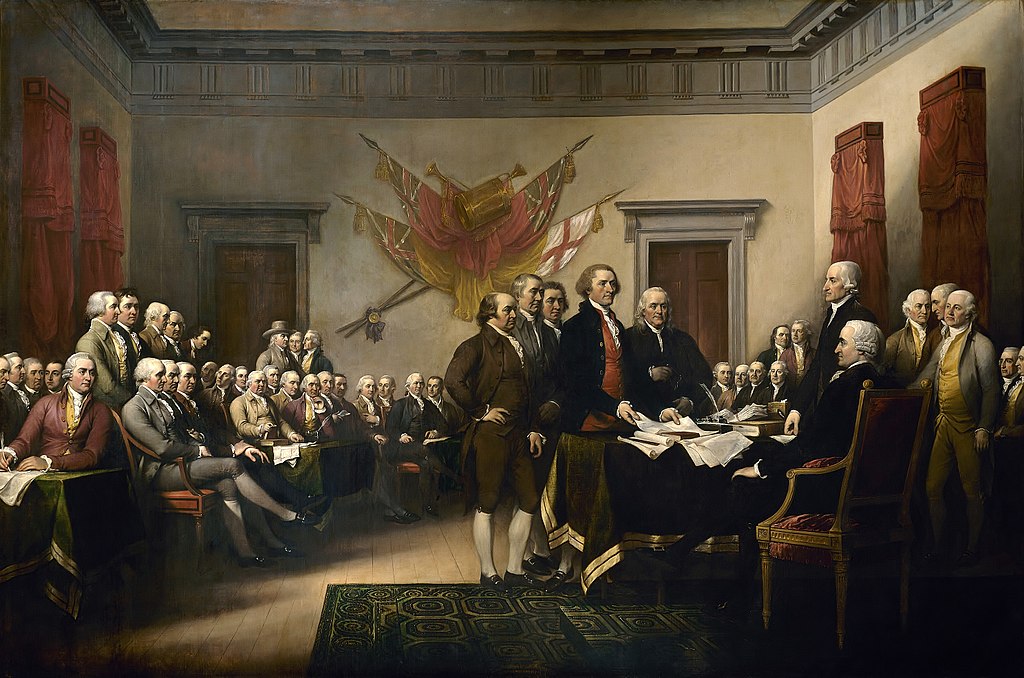
The Declaration of Independence by John Trumbull, 1819
If the Constitution was the result of a compromise, it got criticized by anti-federalists.
North Carolina refused to ratify the Constitution on August 1, 1788, because it didn’t include a bill of rights (the state finally signed it on November 11, 1789). Maryland’ general Attorney Luther Martin, delegate of its state at the Philadelphia convention, refused to sign the 1787 Constitution because it didn’t explicitly condemned slavery. Rhode Island was the last state to ratify, not without difficulties, it in 1790 after refusing it by referendum in 1788, by 34 delegates for and 32 against.
The Constitution had to come into effect as soon as the ¾ States would sign it, which happened in 1788.