Rise of opposition
Years 1763-1774 saw the rise of colonial opposition in response to British claims, marked by a series of economical laws, quickly repealed by central power.
The Seven Years’ War consequences
The Seven Years’ War (1756-1763) was a conflict between European powers and completely emptied the Crown’s cashbox. After the war, the British debt was up to £317.000.000. The government decided to keep an army of thousands of men in the colonies, the cost being around £300.000 per year. As the Thirteen colonies were quite prosperous, Great Britain decided a part of the war and soldiers’ retention fees would be supported by American settlers.
The royal proclamation of 1763 had three major goals:
- Organize the British colonial empire in North America.
- Pacify the relationship with Amerindians, especially after Pontiac’s uprising, in order to stop financial speculation
- Soothe (= appaiser) the Amerindians’ fear of a massive white farmers arrival on their territory.
“The Frontier” attracted migrants eager of lands like Scots and Germans. The ground’s poverty in the East and demographic pressure fostered the settlers’ desire for land.
George III’s proclamation forbid the Thirteen Colonies’ inhabitants to settle and buy land West of the Appalachian Mountains. The Crown kept for itself a part of the American wood and the monopoly in the acquisition of native Americans’ lands: it guaranteed the natives protection. London had planned the construction of British forts along the Frontier, it was supposed to force the respect of the Proclamation and also favor furs trade with the natives. London considered the forts had to be paid by the settlers, claiming the goal was to protect them.
The royal proclamation of 1763 raised discontent through the settlers already installed in the natives’ territory. They had to lend back the land and go back to the colonies. Some were persuaded that the King’s goal was to block them on the coast in order to control them better. Settlers refused to finance the construction and the maintenance of the forts. Settlers estimated that, with the French in Canada, they no longer needed British protection. Americans had a hard time dealing with permanent British armies in the colonies even if peace was back: it was only seen as a tool of British tyranny.
Laws
In April 1764, the Parliament voted the Sugar Act: it maintained tax-raising on sugar and molasses while extending it to other goods (wood and iron). It led to a crisis in rum production and raised once again discontent.
A few days later, the Currency Act forbid the issue of banknotes (= émission de billets de banque) in the Thirteen colonies, allowing London to entirely control their monetary system. Colonial assemblies lively objected to this measure destined only to reinforce the pound’s primacy.
The Stamp Act (1765) established a revenue stamp (= timbre fiscal) compulsory on every official document, newspapers and other articles. This law affected every settler and not only merchants. It was only barely applied because of the American resistance and pressure.
The House of Burgesses adopted Patrick Henry’s resolves on the Stamp Act (Stamp Act Resolves). He declared that American had the same rights as British subjects, especially the right of not being taxed without the consent of their representatives. Those who would support the British tax would be considered as enemies of the colony. Governor Fauquier preferred to dissolve the House of Burgesses as a reaction to those radical propositions.
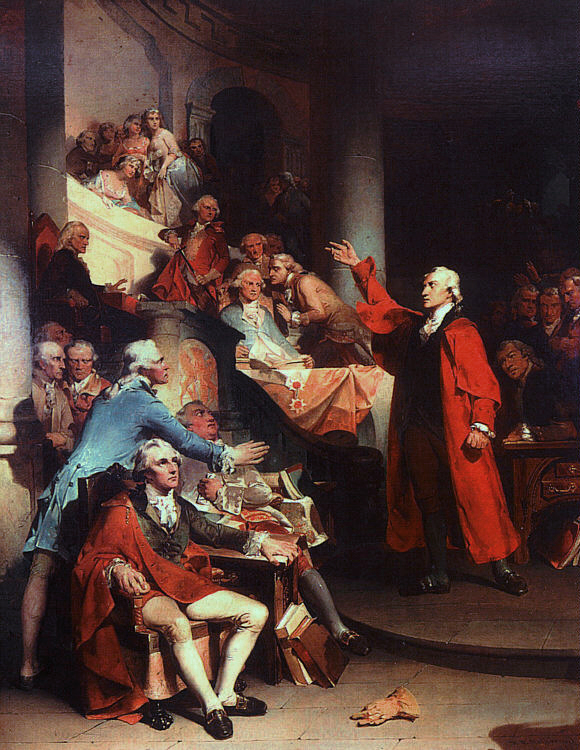
Patrick Henry’s speech against the Stamp Act in front of the House of Burgesses in 1765, by Rothermel, 1851
On March 24, 1765, the Parliament enacted a first Quartering Act, demanding to the colonial assemblies to provide supplies for the British troops. This decision triggered a series of riots in American cities like Boston. The strongest resistance was in New York: the assembly refused to finance the troops and got suspended in return in December 1766.
27 delegates from nine colonies foregathered in New York in October 1765 to establish a common position: The Stamp Act Congress, the name given to this reunion, adopted a Bill of Rights and Grievances, and sent letters and petitions to London. They claimed the power of colonial assemblies when it came to taxation, but also settlers’ right to be represented at the Parliament. Under boycott and demonstrations, the Stamp Act was revoked on March 18th, 1766, without dealing with the political representation of Americans. The Stamp Act was replaced by the Declaratory Act who marked a reinforcement of central authority at the expense of (= au détriment de) colonial assemblies.
The crisis continued in 1767 with the Townshend Acts, creating a tax on raw materials imported in the Thirteen Colonies. Its aim was to finance colonial administration and reduce the budget deficit. In June 1768, the Massachusetts governor pronounced the assembly’s dissolution: the other colonies affirmed their solidarity with the representatives. In September, around a hundred Massachusetts’ delegates gathered in a convention. London sent more troops to maintain calm in Boston. In May 1769, in front of the House of Burgesses, George Washington read George Mason’s proposal to boycott British products until the Townshend Acts’ revocation. The Virginian governor forbid the assembly.
On March 5, 1770, during a violent demonstration in downtown Boston, British soldiers shot the crowd. Five persons died in the “Boston massacre”. Boston’s newspapers used the event as a symbol of British oppression. Great Britain abrogated the Townshend Acts in March 1770, even though it kept the tax on tea.
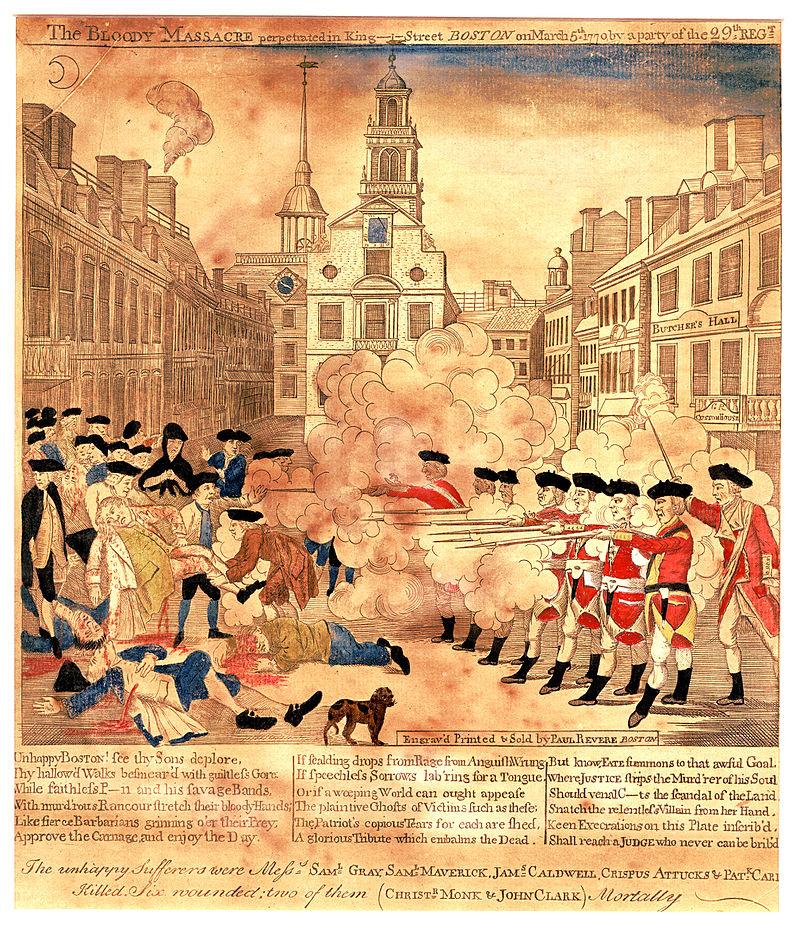
The Bloody Massacre perpetrated in King Street Boston on March 5th, 1770, by Paul Revere according to an engraving from Henry Pelham and colorization by Benjamin Edes
The Tea Act was voted in 1773, in order to allow the East India Company to sell its tea to the Thirteen Colonies without taxes. This law’s goal was to reestablish the company’s finances by reinforcing its monopoly, but it ruined independent merchants.
In December 1773, during the “Boston Tea Party”, settlers disguised as native Americans threw more than 300 tea crates (= caisses en bois) over the docks. As a retaliation, Great Britain decided a series of radical measures destined to reestablish order: Massachusetts council will know be chosen by the King and officers will be nominated by the Governor. Boston harbor was closed, unoccupied houses were requisitioned to shelter British soldiers and the judiciary procedure was amended (= réformer). Those new laws, called Intolerable Acts by Americans and Coercive or Punitive Acts by British, are a crucial stage in the beginning of the American Revolution.
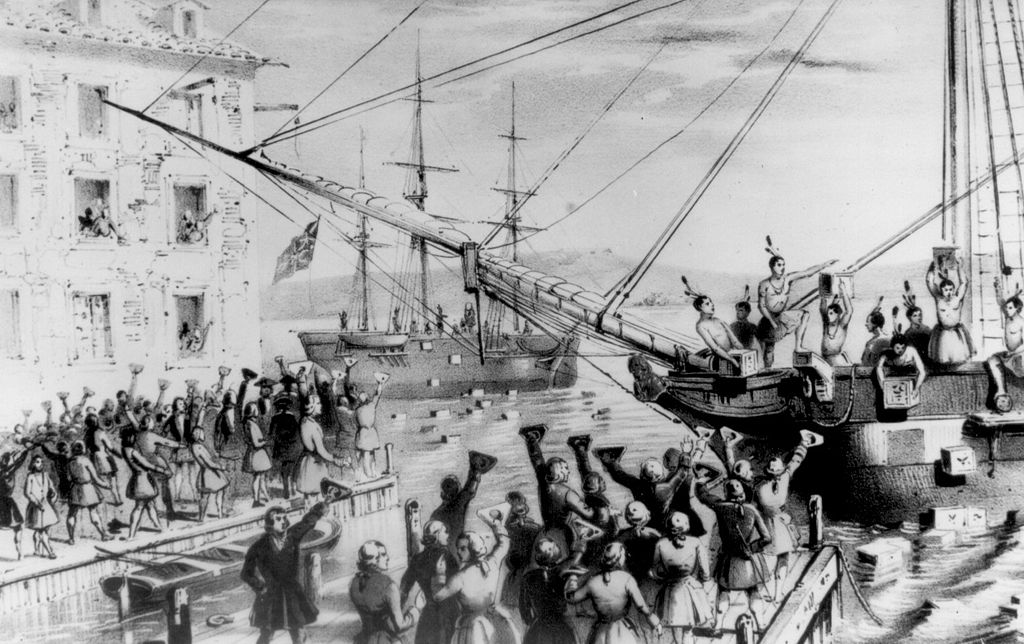
Representation of the Boston Tea Party, lithograph by Sarony and Major, 1846
American opposition
During years 1760-1770, American settlers organized resistance and protest towards British policy. They led violent actions and created solidarity networks, even though colonies were huge. The major places of agitation were Virginia, New York, Philadelphia and Boston.
More and more radical actions
The use of boycott and petitions as soon as 1764 in Boston was one of the most effective solutions against London’s power. Lots of journalists and jurists wrote in favor of the Americans. The lawyer James Otis Jr. (1725-1783), to whom we allocate (= attribuer) the quote “Taxation without representation is tyranny”, wrote several pamphlets against Great Britain’s colonial policy. In 1764, he published The Rights of the British Colonies Asserted and Proved in which he defended the universal and imprescriptible rights of the settlers by calling on (= faire appel à) John Locke’s philosophy.
In 1767, another lawyer, John Dickinson, published Letters from a Farmer in Pennsylvania, in which he presented the reasons why people were discontent. It had quite a stir (= retentissement).
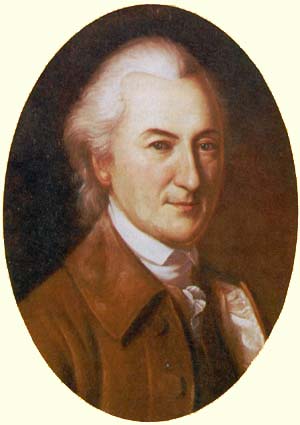
John Dickinson’s portrait by Charles Willson Peale, 1780
In 1770, Alexander McDougall published an anti-British libel (= libelle, petit livre diffamatoire, satirique ou insultant) and went to prison. This period was also marked by passionate debates in colonial assemblies: in May 1765, Patrick Henry made a vehement speech in the House of the Burgesses, claiming the death of George III.
During years 1764-1774, demonstrations succeeded one another to demand the acts revocation. Violences multiplied against British authority representatives. Urban riots were mostly against governors but also custom and taxes officers. The crowd could use the tarring and feathering torment (= supplice du goudron et des plumes) against them
Extract from HBO’s miniseries John Adams. Warning: it might be difficult to watch for sensitive people.
In 1765, rioters hanged and burnt an effigy of Andrew Oliver, a Massachusetts public official responsible for implementing the provisions of the Stamp Act. His office was burnt down and his house plundered (= piller), just like governor Thomas Hutchinson’s house.
Violence reached the loyalists, between 1768 and 1770, opponents put offensive posters saying “importer” on the shops of those who refused to boycott British products.
In 1772, a British schooner (= goélette, un bateau) charged with the control of trading ships is burnt by patriots in the waters off (= au large de) Rhode Island. It’s the Gaspee affair.
In 1774, John Malcolm, a Boston custom officer, is forced to drink boiling tea, undergoes the tarring and feathering torment and is whipped (= fouetter).
Settlers more and more organized
The Sons of Liberty, a secret organization of American opponents formed in 1765, led different actions going from pamphlets to the edification of Liberty poles. The sociological profile of the Sons of Liberty isn’t quite uniform: we could find both lawyers and workers. The most important representatives of this movement were Paul Revere, Thomas Young, Joseph Warren, Patrick Henry, John Hancock, James Otis, John Adams and his cousin Samuel Adams.
Gradually, the actors of the political contestation wanted to coordinate their actions. At the end of 1772, after the Gaspee affair, Samuel Adams thought about the implementation of Committees of Correspondence. They would allow to establish a network between American patriots’ associations and relay the boycott calls. In the beginning of 1773, Virginia got the first committee, Thomas Jefferson and Patrick Henry being part of it. Committees of Safety were also created after that in order to ensure the execution of the resolves taken by the committees of correspondence and the Continental Congress.
The first Continental Congress, September to October 1774
In the beginning of fall 1774, the Thirteen Colonies sent their delegates to form inter-colonial assemblies, first the Stamp Act Congress, then the Provincial Congress.
In 1774, after the Intolerable Acts, Bostonians called out the solidarity of other colonies. In June, Massachusetts and Virginia’s assemblies got dissolved by their governors. Joseph Galloway from Pennsylvania proposed the creation of a bicameral (= bicaméral, se dit d’un régime ou système constitutionnel dans lequel existent deux assemblées représentatives réunies au sein d’un parlement) assembly composed of London’s Parliament and a national American assembly. Budget decisions couldn’t be ratified without the approval of this American assembly. Five states voted for, six against, the idea of a compromise was lost.
The ultimate step, the one who marked the passage from contestation to revolution, was the one of the First Continental Congress, a highly illegal act in the eyes of the mainland: this Congress created an independent political assembly which goal was to coordinate the action of colonies against London. As soon as September 1774, Americans used the word “State” to designate the Thirteen Colonies.
In October 1774, the Continental Congress of Philadelphia demanded the acknowledgement of American liberties: a continental association was created and charged to organize the committees of correspondence and the boycott until the revocation of the Intolerable Acts. The Congress sent a Petition to the King. The assembly called out the Canadians to join the insurgents in the rebellion, but in vain. Canada remained loyal to London and even hosted American loyalists. Finally, the Congress’s delegates decided of a Second Continental Congress on May 10th, 1775.