The American war of Independence, 1775-1783
In the beginning of year 1775, Americans plundered (piller) armories and organized militias. However, the american forces were way inferior compared to the british army, quality and means included. Violent actions multiplied: in a speech made in St. John church in Richmond, Virginia, Patrick Henry declared “Give me liberty, or give me death!”.
First fights in the North, 1775
The first battle opposing British soldiers to Americans was the Lexington and Concord one, a few kilometers west of Boston (April 1775): this skirmish (= escarmouche), which end was in favor of the insurgents, caused 73 British deaths and 49 American deaths. It was the beginning of a guerilla.
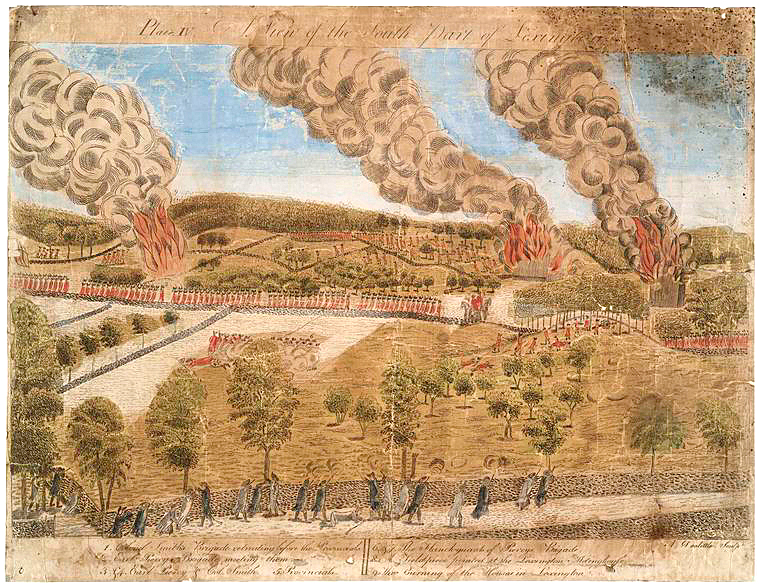
Lexington’s battle, engraving, 1775
On May 10th, 1775 was the first reunion of the Second Continental Congress in Philadelphia. This congress named George Washington as the head of the continental army. The general had to deal with seriously undisciplined troops. At the beginning of the war, money lacked to pay soldiers and desertion was frequent. However, Americans were deeply determined.
The Congress called out Canada again. On July 8th, they sent the Olive Branch Petition to George III, a conciliation attempt rejected by the king. Americans besieged (= assiéger) Boston (April 1775 - March 1776). They finally withdrew to New-Scotland.
Political revolution, 1776-1777
In 1776, Thomas Paine published a pamphlet called Common Sense, in which he criticized monarchy and had an important success. Thomas Paine wanted America to split from Great Britain and proposed a republican constitution. In a letter published by the Pennsylvania Packet in April 1776, he showed Americans every advantage of being independent. To Thomas Paine’s opinion, Americans were a free and virtuous people who could liberate itself from the past.
Between 1776 and 1780, the American States gave themselves written constitutions based on faith into public virtues.
The texts planned two assemblies and annual elections: the democratic principle was adopted everywhere by censitary suffrage (suffrage censitaire, opposé au suffrage équivalent, les votes n’ont pas la même valeur en fonction du rang de la personne), but not in Vermont where universal suffrage was granted to white men.
The Constitution of Virginia (June 1776) affirmed human rights, some of which would be taken up (reprendre qch) in the United States Declaration of Independence: it’s the first time in human History that a constitutional text stated universal and inalienable rights. The Constitution of Pennsylvania (September 1776) implemented conscientious objection (objection de conscience) and freedom of worship. The constitutions of five States out of thirteen stated the need of public instruction.
In Philadelphia, after numerous debates, the Continental Congress voted the Declaration of Independence on July 4th, 1776. This text, its main author being Thomas Jefferson, represented the “_inaugural act of the American nation_”. Its preamble (préambule), inspired by the Lumières’ ideas, proclaimed the right to freedom, life and happiness for settlers.
British movement to the center, 1776-1777
After Long Island’s victory in August 1776, British troops occupied New-York city in September. The American troops had to withdraw to New Jersey. Philadelphia was occupied in Fall 1777: the Congress had to flee the city as well as two thirds of the population. Washington was defeated in Pennsylvania and had to go to Valley Forge for the Winter, in awful conditions. However, after Saratoga’s battle, in the state of New-York, British commander John Burgoyne had to surrender in Horatio Gates in October 1777. This American victory encouraged France to engage in war, helping the insurgents.

Washington’s headquarters in Valley Forge
French alliance and final victory, 1778-1783
An alliance treaty got ratified in February 1778, in Paris, between France and the United States, thanks to Benjamin Franklin’s diplomatic action. French hoped to get their revenge on Great Britain. Spain joined the alliance in May 1779, followed by the Dutch Republic in 1780.
In June 1778, British troops left Philadelphia in order to go defend New-York, threatened by a French maritime intervention. As of (à partir de) 1779, the British attacked the Southern states.
Between May 1780 and September 1781, a series of battles happened in South Carolina, sometimes in favor of London, sometimes in favor of the Americans. The British defeat during the battle of Yorktown, Virginia, in October 1781, marked a turning point in the war.
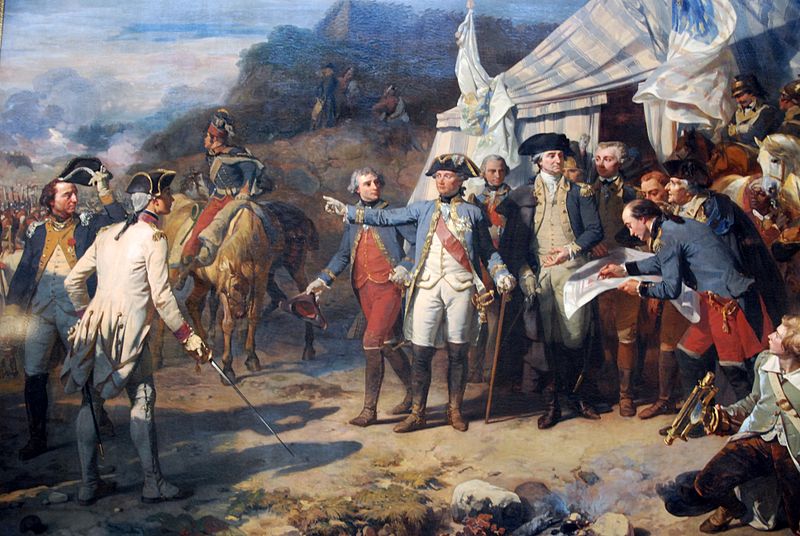
French general Rochambeau and general Washington giving their orders for Yorktown in 1781, by Auguste Couder, 1836
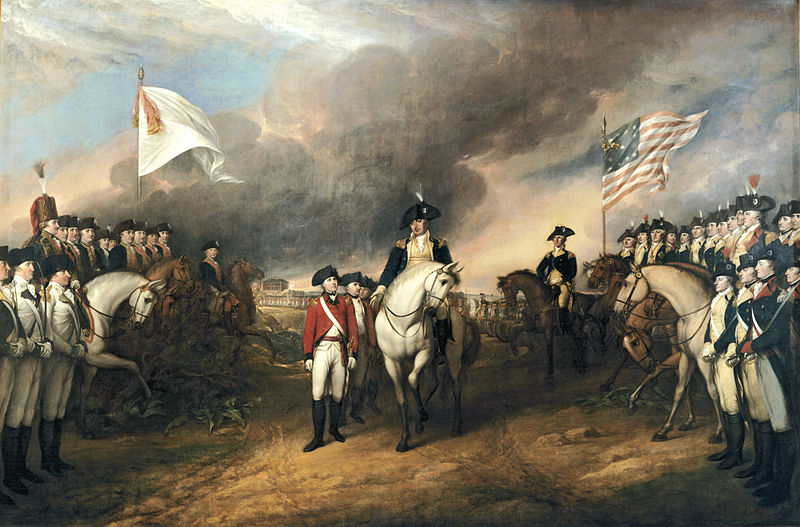
Capitulation of British general Cornwallis in Yorktown, by John Trumbull, 1820
The House of Commons adjudicated (se prononcer) for the end of the war on February 1782, British Prime Minister Lord North resigned in 1782. Negotiations started with the Crown and a preliminary treaty was agreed on November 30th, 1782.
The Treaty of Paris, ratified in September 1783, officially ended hostilities and the United States was acknowledged once and for all. Its frontier was the Mississippi river.
The Peace of Paris, signed the same year, resolved the litigations between Great Britain and the European allies of America.
The birth of the Confederation, 1777-1781
The american unity advanced in 1777 : a flag was adopted in June.
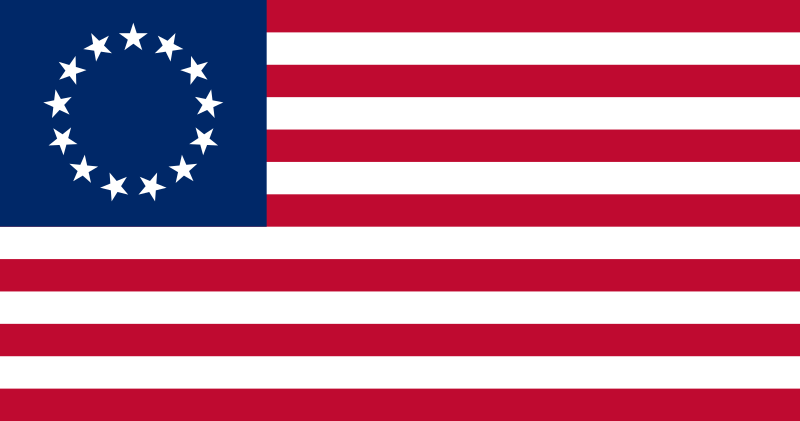
The first American flag
The coordination of military efforts against Great Britain and the supplies given to the Continental army drove the Americans to unite. Loans and the debt reimbursement also needed a reinforcement of federalist centralization: the war of Independence led to the union of the old colonies.
In 1777, the Articles of Confederation and Perpetual Union were voted by the Continental Congress. This constitutional document organized the Thirteen States as a Confederation (union of sovereign states, united for purposes of common action often in relation to other states, it tends to be created in order to deal with critical issues), and declared the existence of the United States, letting the federal States their own sovereignty. The document imposed a mutual armed help and an elected congress to represent the country in international relationships.
Then, the United States created an embassy, a national Treasury (= Trésor public) and a bank. Titles of nobility were abolished and the first ministries were implemented.
The Articles of Confederation were put in place only after being ratified by the States, in March 1781. However, for its financial resources, Congress mostly depended on the good will of the States. Nothing was intended for the Congress to prevail its authority on the States, the belief in public virtue being so strong.
Only a low percentage of the 2.5 million inhabitants was volunteer to fight against the British. States refused to give supplies to continental army’s troops. Soldiers suffered from lack of food and clothing.
The elaboration of the Articles of Confederation brought up oppositions between those who wanted a strong central power and those who were in favor of a huge autonomy for the States. The first ones got called “nationalists”, then “federalists”. Debates were also about the distribution of fiscal charges, the way to vote and the expansion to the West.